Documenting the research, history, and restoration of a rare 64 1/2 K code convertible.
Friday, October 6, 2017
Assembly Begins
Saturday, August 5, 2017
Rear Axle Assembly
Finished assembly of the differential to the axle housing. Been a really long time coming but finally finished detailing all of the sub-components and fasteners. I posted a while back the details of the fastener restoration, the whole thing looks amazing. Haven't had a chance yet to add the factory markings yet.
Here's another picture of the components laid out so that you can see all that goes into this thing. Whole differential was completely rebuilt, gears look like new but are actually vintage.
I am really happy with the way that the different parts came out, the the right amount of tumbling, etc. to get these parts looking like they did when the car was first assembled. None of the metal is painted, it's the natural metal finish that was there originally.
Nest step is to finish recreating factory markings on the leaf springs, and getting them installed. The axle housing assembly will then get installed followed by insertion of the axles and bolting on the brake backing plates.
Monday, April 24, 2017
Spring Markings
As I progress through the next steps to installing the drive train and engine, I'm going through suspension parts to make sure that everything is done and ready to install. Gotta have the suspension installed prior to installing the engine of course. Searched for pictures that I took of the rear leaf springs before restoration because I remembered that there were some interesting paint marks on them that I wanted to recreate prior to installation. Here they are after soaking in Evaporust. The top two pictures show the bottom of the uppermost leaf springs, with white paint going the entire length of the spring. The way its done on the two is very different.


The bottom two pictures, above, show a single white dot on each spring. On the right the dot is partially obscured by where one of the straps rubbed it off, tape measure shows that the one on the left is about 16 inches aft of the centering bolt. Below is a wider view of the whole spring showing the location of the paint daub.
Front coil springs were black (dipped these in paint many posts ago) now ready to apply the top to bottom chocolate brown stripes on each along with the white stripe on about half the length of each spring, which according to period Ford literature: "The Load Pounds figure shown indicates the mean load. Usually, there is a variance of 30 to 50 lbs. plus or minus of the load pounds indicated in the chart. If the tested load rate is on the mean to low limits, a white stripe is shown in addition to the other identification markings."
You can see the chocolate brown stripe to the left of the white on the right hand spring above and below.
So apparently the tested load rate for these springs was on the 'mean to low' limit. The Ford spring chart shows that brown indicated a mean load of 1516 lbs, so these must have tested 30 to 50 lbs. below that. The 1516 spring rate is the highest available at the time for a Mustang and was indicative of the Special handling package that came on the K code convertibles. What's interesting is that the chart shows the same spring whether the K code had power steering or manual steering (but power steering wasn't an option for the K codes, supposedly). So it would make sense, although the chart doesn't specifically indicate it, that a K code convertible without power steering would be expected to weigh-in 30 to 50 lbs less without the power steering equipment so springs that tested to the low end of the mean load rate would be chosen...pretty cool that they were trying to match the springs so accurately to the particular car. So for this car they chose springs that were in the range of 1461 to 1481 lbs. With this car being one of the first K code convertibles that the assembly line had seen, they wouldn't have known that there weren't any power steering K-codes - so given what we know about no options for A/C or power steering, we would expect all 64 1/2 K code convertibles to have been delivered from the factory with springs of this type, with the brown and white identification markings.
Of further interest, the chart shows that the same spring is used on K code convertibles with A/C (again supposedly not an option for K codes), but in combination with a C4DZ-5355-A shim which somehow brought the spring rate to 1491 lbs.


Of further interest, the chart shows that the same spring is used on K code convertibles with A/C (again supposedly not an option for K codes), but in combination with a C4DZ-5355-A shim which somehow brought the spring rate to 1491 lbs.
Friday, April 21, 2017
Motor Markings
You'll also notice that I reconditioned and reused the original oil gallery plugs. They turned out great and are different that what is available to replace them. Note how the square head rear plugs each have a little bump/raised dot on the top of each one.
Thursday, March 30, 2017
Engine Assembly Begins
Anyways, soft water jacket plugs are in now, along with the oil filter adapter.
So the front oil gallery plugs are an interesting subject. Every engine rebuild book, states that there are three 1/2" diameter oil gallery plugs on the front of the engine....And there are BUT, there is also, on some of these early 289s, a 1/4" plug to the right of the front cam bearing. Here's a picture of the original plug. So glad I removed this and got in here and cleaned, there was a ton of black gunk in behind here. That was another afternoon of re-cleaning all of the front oil galleries connected to this plug hole.
Just look at all the stuff left behind this plug...and to think some people don't remove this when they do a rebuild. Makes me wonder about all those "rebuilt" engines on Ebay and such...
Every 289 soft plug kit I've seen fails to include this plug and they are not easy to find.
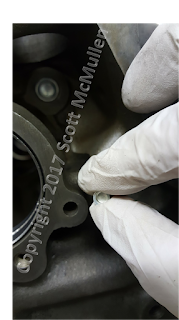
In fact, if you do a compatibility search on most auto parts websites, this 1/4" plug will not come up as a compatible part for ANY 289 engine. There are a couple of suppliers that make 1/4"diameter plugs, and I was able to obtain a few of them, (extras just in case I messed a couple of them up during install, they are tiny and are easy to get in crooked and or dropped). There is a later version of the cam thrust plate that covers this and guides oil to the front surface of the cam, but on early cars like this, the thrust plate doesn't cover the hole.Here the front oil gallery plugs after installation
As I mentioned the crank was also a bear to get clean. Pic here before polishing and final cleaning showing remnants of orange paint on the counter weights. Usually expect to see the orange paint on the rear counter weights, but was only able to see paint on front few.
Front cover after cleaning. This thing spent a long time is 160 degree degreaser, but it came out looking great. Casting date is April 1964. No oil fill hole, and no oil fill plug, this was the latest casting design for the front cover at the time.
Inside is nice and shiny, just like when new.
Friday, February 3, 2017
Bill's Story
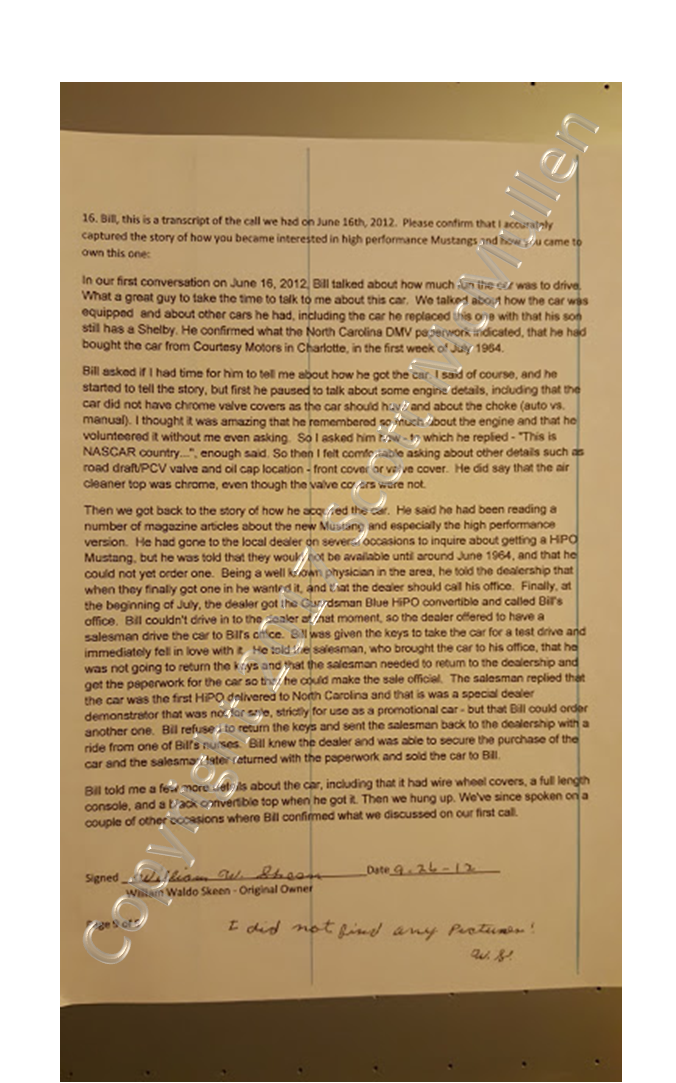
Bill is the original owner of the car. I mentioned in an earlier post that I would be providing more details about how Bill acquired the car. His story is very interesting and provides some unique insite on how excited the public, and particularly "car people" were about the Mustang. There was a tremendous about of excitement about the Mustang, but even more about the rumored High Performance version that was promised on Jun 1st, 1964. The pictures below were taken in Jan1974 by Jay, shortly after he acquired the car. As you can see in the transcript of my first conversation with Bill, and signed by Bill, he stated that he couldn't find any pictures of the car when he had it - I figured I post these instead. Bill stated that the car originally had a black top, and Bobby the second owner, said that he was the one that put the white top on.
In out first conversation on June 16th 2012, Bill talked about how much fun the car was to drive and how he got the car. He said that he had been reading about the new High Performance Mustang and had gone to his local dealer and friend to buy one, but was told they wouldn't be available until June. He told his friend that when they got one he wanted it. Bill's signed affidavit is below with more detail (this a copy, the original is in a safe deposit box along with the rest of the questionnaire.)
Thursday, February 2, 2017
Finally the Engine
So much effort has gone into this engine. It's finally time to do the final cleaning and get it assembled. Here's the back of the engine with the original markings
Here the markings have been enhanced.
Here it is without the white "X", (which I am told is an inspection mark) to better show the yellow text.
Here's what it looks like just before final cleaning.
The intake had a couple of interesting markings, barely visible, but there is an orange check mark over the thermostat recess, and another to the right by the front corner bolt.
Here the markings have been enhanced.
Here it is without the white "X", (which I am told is an inspection mark) to better show the yellow text.
Here's what it looks like just before final cleaning.
The intake had a couple of interesting markings, barely visible, but there is an orange check mark over the thermostat recess, and another to the right by the front corner bolt.
Subscribe to:
Posts (Atom)